TeamPhoto GaleryEquipmentServices

About the Laboratory

Established in 1987, the GEOECOLAB laboratory specializes in mineralogy, environmental geochemistry, and environmental science. It provides scientific and technical support in the fields of geology, geochemistry, mineralogy, and analytical research, as well as in other related areas of interest.
The laboratory focuses on the continuous improvement of the quality of its activities and services, the practical implementation of research ideas, the consistent pursuit of established objectives, and the delivery of high-quality services to ensure client satisfaction and meet their expectations.
The laboratory fosters an organizational culture characterized by motivation, creativity, participation, and efficiency, the achievement of sustainable results, teamwork, the creation and maintenance of a strong professional image, open communication, accountability in decision-making, and a performance-oriented mindset.

Strategic objectives

  • Continuously improving the quality of activities and services provided, while diversifying the range of offerings to meet the needs of clients and beneficiaries.
  • Developing and expanding experimental laboratory techniques and methodologies applicable to the institute’s field of activity.
  • Continuously training and preparing staff to enhance professional competence and adopt the latest best practices through training and research placements at partner laboratories, academic institutions, and geological services—both domestic and international.
  • Implementing and continuously improving the effectiveness of the laboratory’s quality management system.
  • Consistently providing quality services to ensure beneficiary satisfaction and meet their expectations.
  • Leveraging opportunities for synergistic collaboration with other teams within the institute or at other institutes—both in Romania and abroad—particularly with laboratories belonging to EuroGeoSurveys member institutions.
  • Identifying potential for effective collaboration with thematic research groups and participating in relevant projects.
  • Securing funding through national and international projects and programs.
  • Ensuring external visibility through both outreach initiatives and the development of applications of general interest.

Staff
The professional structure includes specialists from related fields, staff made up of researchers with outstanding experience in the laboratory, with skills and performances demonstrated by the number of published scientific works, as well as by effective participation in the realization of national and international projects, doctors of science, as well as young doctoral and master’s students who have completed initiation and improvement internships on the analytical techniques used in the laboratory at prestigious universities and institutions both in the country and abroad.

Services
Through its organizational structure and existing infrastructure, the GEOECOLAB laboratory offers a wide range of services—spanning fields of general interest (geology, geochemistry, mineralogy, hydrogeochemistry, environmental protection) as well as highly specialized or emerging areas—in compliance with national, European, and international standards. These services utilize specific methods adapted to any natural or artificial environment and are tailored to meet the specific requirements of any client.

  1. Quantitative single-element analyses of solid and liquid samples (water, soil, sediment, rocks, animal and plant tissues) to determine the presence of Al, Ag, As, Au, Ba, Bi, Ca, Cd, Co, Cr, Cu, Cs, Hg, K, Mn, Mg, Mo, Na, Ni, Pb, Sb, Se, Sr, V, Te, Zn, and Zr using atomic absorption spectrometry.
  2. Qualitative and quantitative chemical analyses (percentage composition).
  3. Determination of mercury content in solid and liquid samples via combustion using a dedicated mercury analyzer.
  4. Identification of minor and major element content in solid samples using X-ray fluorescence (XRF) (covering elements from Be to U, excluding Li, inert gases, and actinides).
  5. Analysis of molecular compounds using UV-VIS-NIR spectrometry.
  6. Sample preparation for electron microscopy analysis: cutting rock samples to produce thin and polished sections; computer-controlled, micron-precision sample cutting; grinding surfaces to achieve high image resolution; cleaning samples of dust or organic deposits in an ultrasonic bath; coating samples with various metals and carbon; and cryopreservation.
  7. Preliminary sample analysis: examination using stereomicroscopes and ore microscopes, and preliminary analysis using a tabletop scanning electron microscope.
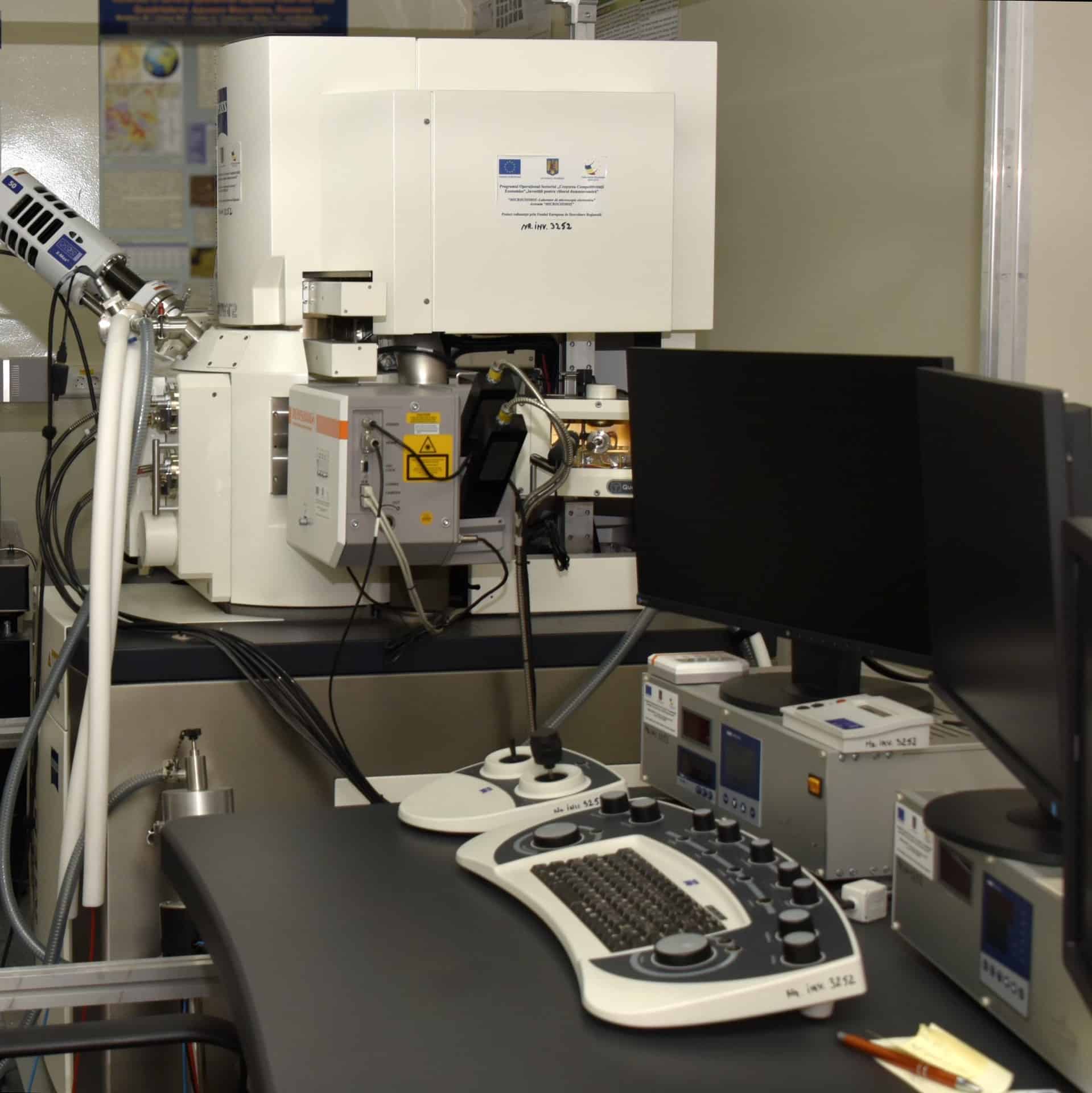
  8. Compositional and structural analyses: chemical and structural analyses at magnifications of up to several hundred thousand times, featuring high-quality imaging and elemental distribution mapping using a Zeiss Merlin Gemini 2 scanning electron microscope equipped with backscattered and secondary electron detectors, two X-ray fluorescence spectrometers (Energy Dispersive – EDS and Wavelength Dispersive – WDS), and a Raman spectrometer.
  9. Field-based chemical analysis of rocks, ores, soils, and sediments using portable ED-XRF equipment.
  10. Field activities (geological sample collection) and *in situ* measurements: pH, conductivity, and turbidity.
  11. Thermal studies: loss on ignition and organic content percentage.
  12. Microwave digestion of solid and liquid samples for quantitative analysis.
  13. Qualitative and quantitative analysis of major constituents, minor elements, and trace elements in rocks, ores, soils, natural or wastewater, and animal or plant tissues.
  14. Determination of index elements to assess the economic potential of mineral deposits.
  15. Determination of the chemical composition of natural or artificial products to assess their purity or contaminant levels.
  16. Studies on the impact of natural and/or anthropogenic factors on environmental conditions.
  17. Monitoring of environmental factors in areas at high risk of pollution.
  18. Acquisition of qualitative information regarding the topography and chemical composition of the studied surface via electron microscopy (using backscattered electrons); generation of three-dimensional topographic images of the scanned surface.
  19. Elemental distribution maps of the chemical composition of the surface examined via microscopy.
  20. Distribution maps of all chemical elements present on the surface examined via microscopy.
  21. Qualitative and semi-quantitative chemical analyses.

Technical Equipment
The GEOECOLAB laboratory possesses a high-performance, multidisciplinary research and development infrastructure—comparable to that of similar European institutions—that meets the quality requirements set by international standards.
It is one of the best-equipped laboratories in the country, featuring modern analytical instrumentation and state-of-the-art software, as well as researchers specialized in the operation of specific equipment; the laboratory operates under the coordination of, and provides support to, the National Museum of Geology (a Facility of National Interest). It enables a wide range of analyses on inorganic and/or organic samples—whether solid or liquid, and originating from natural or artificial environments—utilizing the following equipment:

  • Cutting large rock samples for the preparation of specimens (thick sections or thin sections).

  • For cutting samples prior to subsequent embedding and grinding (preparation of polished sections).
  • for polishing the surfaces to be analyzed in order to obtain high image resolution.
  • ultrasonic cleaning system for powder samples or organic deposits.

High-quality sample preparation system tailored for SEM-EBSD applications, featuring:

  • cross-sectioning and slope cutting;
  • finishing and cleaning for SEM and EBSD samples;
  • high-energy ion gun for rapid milling;
  • low-energy ion gun for surface polishing and cleaning;
  • dedicated sample preparation holder with high-precision positioning;
  • real-time, high-resolution monitoring of the milling process.
  • system for coating samples with metals and graphite to allow the drainage of excess electrons to ground for samples to be analyzed under an electron microscope.

  • sistem de dezagregare a probelor cu matrice complexă în vederea analizelor spectrometrice.

  • ultrapure water production system.

  • necessary for the preliminary inspection of rocks, minerals, powders, and microfauna, and for mounting them onto electron microscope supports.

  • used to reveal minerals within rocks or other crystalline compounds.

  • used for the identification and semi-quantitative analysis of elements ranging from magnesium to uranium; also useful and necessary for acquiring primary data in hard-to-reach locations.

Used for image analysis, it performs:

  • qualitative and quantitative chemical analyses (detecting elements from beryllium to uranium);
  • image analyses providing qualitative information on the topography and chemical composition of the studied surface, obtained via backscattered electron detection;
  • three-dimensional topographic images of the scanned surface;
  • elemental distribution maps of the chemical composition across the studied surface;
  • distribution maps of all chemical elements present on the analyzed surface;
  • qualitative and quantitative chemical analyses via Energy-Dispersive X-ray Spectroscopy (EDS);
  • qualitative and quantitative chemical analyses via Wavelength-Dispersive X-ray Spectroscopy (WDS);
  • chemical and structural analyses via backscattered electron diffraction;
  • chemical and structural analyses via Raman spectrometry;
  • detection of molecular and crystalline sample structures via cathodoluminescence and photoluminescence.

Equipped with four modules—flame, graphite furnace (for liquid and solid media), and hydride—it performs single-element quantitative analyses on solid and liquid samples (water, soil, sediment, rocks, animal and plant tissues) to identify the following elements: Al, Ag, As, Au, Ba, Bi, Ca, Cd, Co, Cr, Cu, Cs, Hg, K, Mn, Mg, Mo, Na, Ni, Pb, Sb, Se, Sr, V, Te, Zn, Zr.

  • qualitative and quantitative chemical analysis of inorganic samples (solutions containing transition metal ions) and organic samples;
  • analysis of total nitrogen, nitrite, nitrate, ammonium, phosphate, sulfate, and sulfide content in environmental samples, as well as alkali and alkaline-earth metals and heavy metals in soil, sediments, and water, using colorimetric methods.

  • enables the investigation of chemical bonds formed between atoms in organic or inorganic samples; used for the identification and characterization of chemical compounds in complex solid samples;
  • enables the characterization of molecular structures and nanostructures, as well as the analysis of organic compounds in environmental samples and in mineralogy.

  • Atomic absorption spectrometer designed for the high-sensitivity measurement of mercury content in solid and liquid samples—including geological, environmental, and other sample types.
  • The system can be easily converted from CVAAS to direct analysis via thermal combustion AA.

  • qualitative and quantitative analysis of major constituents, as well as minor and trace elements (ranging from sodium to uranium), in rocks, ores, soils, and natural or waste waters;
  • determination of index elements to assess the economic potential of deposits;
  • determination of the chemical composition of natural or artificial products to assess their purity;
  • studies on the impact of natural and/or anthropogenic factors on environmental conditions;
  • monitoring of environmental factors in areas with a high risk of pollution.

  • provides information on the electronic and vibrational structure of the analyzed sample;
  • analyzes any type of solid sample.

  • performs analyses on water samples: pH, temperature, conductivity, turbidity, total nitrogen, ammonium, nitrites, nitrates, phosphates, total phosphorus, total chlorine, free chlorine, suspended solids, *Escherichia coli*, pathogenic coliform bacteria.er, solide în suspensie, Escherichia coli, bacterii patogene coliforme.

  • detects elements ranging from boron to uranium;
  • performs qualitative and quantitative percentage chemical analyses;
  • yields qualitative information on the topography and chemical composition of the studied surface via backscattered electron detection; generates three-dimensional topographic images of the scanned surface;
  • element-specific distribution maps of the studied surface’s chemical composition;
  • distribution maps of all elements comprising the chemical composition of the studied surface;
  • qualitative and semi-quantitative chemical analyses.

Dr. Chim. Monica – Violeta RADU – CS I – Head of Laboratory
georgedinca@rocketmail.com

Dr. Ing. George Dinca – CS III
Dr. Alexe Elena-Veronica – CS III
Ivanov Alexandru Anton – Inginer în domeniul protecției mediului
Filiuță Andra Elena – ACS
Neagoe Jeanina – Tehnician determ. fizico-mecanice II

Contact the team