About the National Core Repository
The National Core Repository is a collection of core samples obtained from boreholes drilled within Romania’s territory since 1938. During the communist era, hundreds of thousands of meters of core samples were recovered through drilling operations in Romania. The majority of these were destroyed after 1990 as a result of the privatization of former geological prospecting and exploration enterprises (IPEG) and the disposal of their core storage facilities. A small fraction of the cores (approximately 60,000 meters) was saved and preserved in the National Core Repository. This facility was established by consolidating core samples held by the Enterprise for Drilling and Special Geological Works (IFLGS—now FORADEX), the Enterprise for Geological and Geophysical Prospecting (IPGG—now Prospecţiuni SA), and the Geological Institute of Romania, supplemented by additional cores from local geological prospecting and exploration enterprises (IPEG) and PETROM.
Most reference structural boreholes—wells drilled to depths of 1,000–1,200 meters or more into the main geological units of Romanian territory to characterize local tectonics and lithology—have core intervals preserved in the National Core Repository. Since the vast majority of cores held in the National Core Repository originate from wells drilled between 1950 and 1990—a period when exploration technology was far less advanced than it is today—they serve as a constant source of new information regarding Romania’s subsurface when analyzed using modern techniques. The scientific value of the cores in the National Core Repository is further evidenced by the fact that, in countries such as Australia, Canada, and the United States, such repositories are referred to as “core libraries.” Scientific and economic interest in these cores is demonstrated by their analysis within research projects conducted over the last decade by the IGR and Romanian university geology departments, as well as by requests from oil companies to examine cores from specific boreholes.
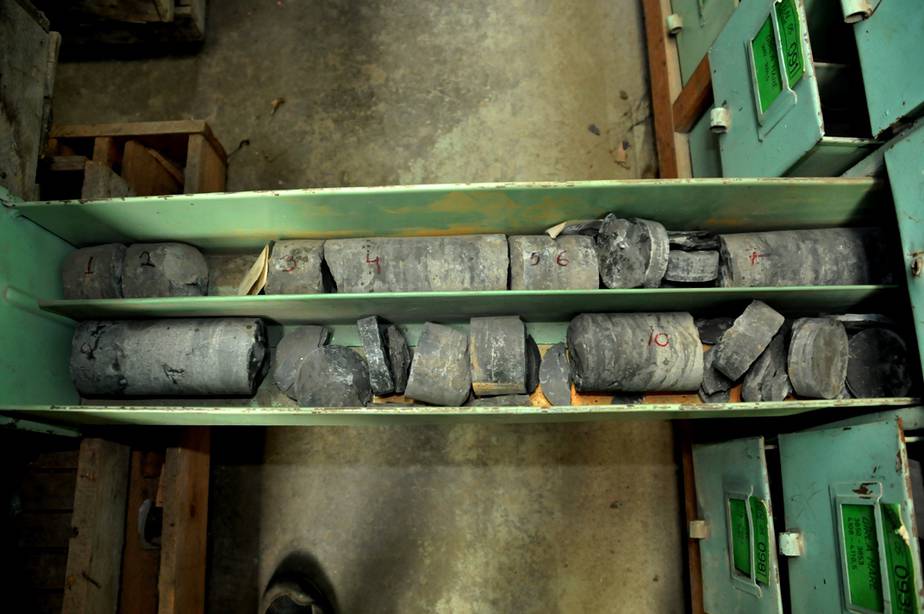
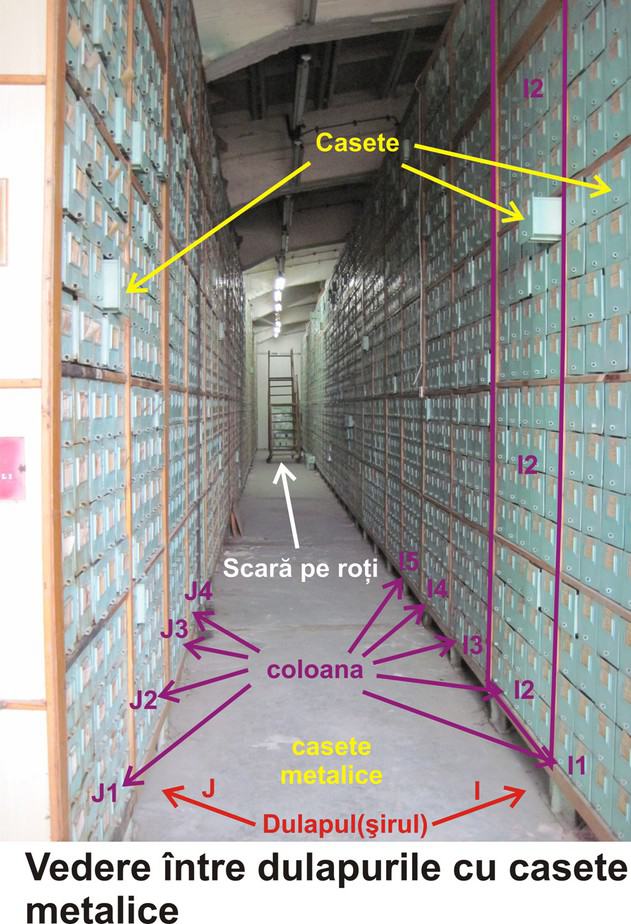
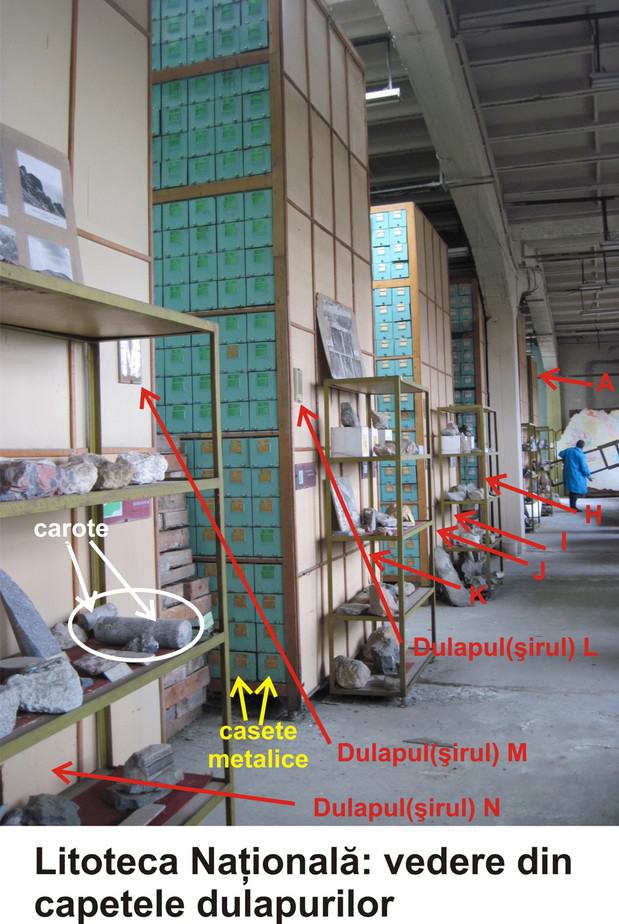
The core samples are stored in specially constructed cabinets made up of metal modules containing 1-meter-long trays. The National Core Repository houses 18 metal shelving units—labeled with letters from A to S—containing over 55,000 metal trays.
In 1983, the administration of the National Lithotheque was transferred from the IPGG to the I.G.R., without the transfer of the facility housing the lithotheque or the land on which it stood, as all geology-related institutions were state-owned at the time. In 2000, following the privatization of Prospecţiuni SA, the facility housing the National Lithotheque passed into private ownership; currently, the I.G.R. is constructing a new headquarters for the National Lithotheque, to which the core samples will be relocated.